
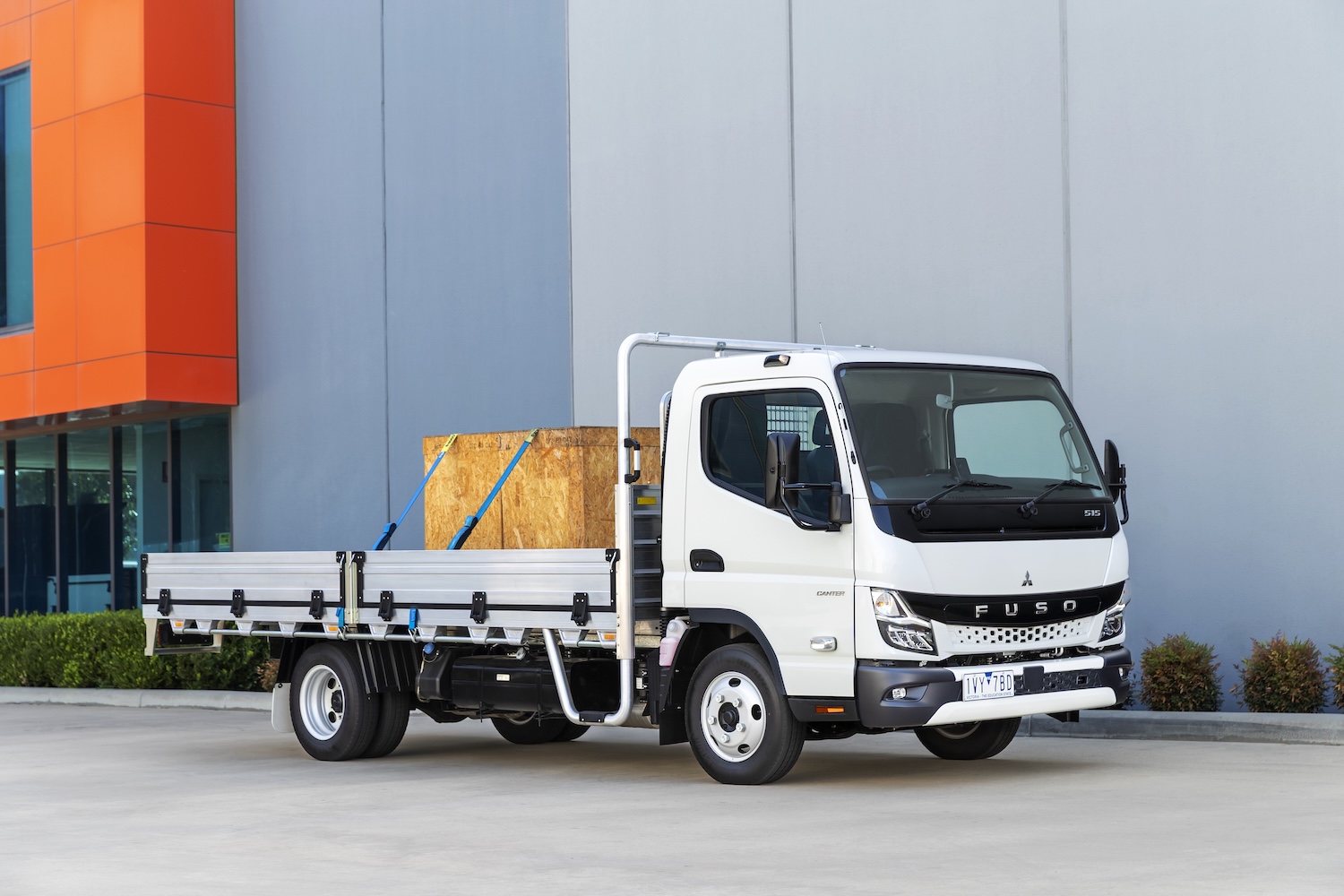
Operating in a super competitive category the Fuso Canter continues to evolve and the latest Euro VI range has upgrades to its engine as well as a freshened cab interior.
A dictionary will describe a ‘canter’ as a particular horse’s gait that is smoother, yet faster, than a trot. While we don’t set out to prove how fast the latest Fuso Canter can go, it certainly impresses with its smoothness.
Fuso upgraded the exterior of the Canter a couple of years ago so this latest version receives only minimal outside changes in the form of fog-lights as standard, as well as new LED tail-lights. The headlights have been LED for a while and provide excellent illumination and an almost infinite service life.
The Canter 515 Wide Cab at the centre of this assessment is powered by a 3.0-litre four-cylinder engine which develops 110kW between 2,840 and 3,500 rpm and now meets the stricter Euro VI emission standards through the use of Exhaust Gas Recirculation, a Diesel Particulate Filter and Supplementary Catalytic Reduction using AdBlue fluid.
The engine has also gained an additional 30Nm of torque and now has a very handy 400Nm on tap across the range of 1,350 to 2,850 rpm. The same Euro VI engine has been in local operation in the Fuso Rosa bus since 2020, so there are no bugs to sort out in the emission control technology. A version of the engine rated at 129kW and 430Nm is also available.
Thanks to the underlying design and engineering, most models in the current Canter range have a payload advantage over their competition.
The Canter 515 model is also now available with a Built Ready Alloy Tray option, which incorporates a clever design of the drop sides to provide a gap along the length of the tray which allows for load straps to run under the 330mm high tray sides in order to provide improved restraint for any load without putting excess strain on the alloy tray sides.
The gap is protected by a rubber weather seal and provides an innovative solution for a problem often encountered with an alloy trays and enables a load to be secured directly to the tray’s heavy duty side tie rails. The tray also features alloy steps and grab handles at the front corners, a mesh lined headboard load-barrier and a three tonne rated alloy floor.
To simulate during our test drive the tray is occupied by a large wooden box which wouldn’t be out of place housing a wild animal, but in this case it’s loaded with ballast.
Standard Canter safety features include Autonomous Emergency Braking, Electronic Stability Program, Lane Departure Warning System and Pedestrian Detection.
For all Canter models except Crew Cabs, the most noticeable upgrade inside the truck is the addition of new ISRI driver and passenger seats which provide a high level of support and comfort and have adjustable dampening to suit the weight and individual requirements of any driver. Achieving a comfortable position is enhanced by the range of telescopic and tilt adjustments available for the steering wheel.
Riding or driving in the cab is enhanced in these new models due to the air conditioning system being upgraded to an automatic mode to allow the comfort of the occupants to be set at a preferred temperature.
The 8-inch LCD touch screen is mounted on the dash and provides wireless Apple Carplay and Android Auto compatible Bluetooth phone connections as well as digital DAB+ radio and the familiar AM/FM radio. There is a USB port for charging of devices such as mobile phones.
The screen also functions as the display for the standard equipment reverse camera and has the capability to accept input from up to five additional cameras. The rear mounted camera has a microphone as well as infra-red abilities for low light operations.
Daimler tells us that around 90 per cent of Canter sales in Australia are for trucks equipped with the optional Duonic six-speed Dual Clutch Automated Manual Transmission, as many buyers prefer the ease of operating a two-pedal light truck.
However, our test vehicle is equipped with a five speed all-synchro manual gearbox which is a delight to operate. The clutch is light and progressive and delivers smooth take offs, enhanced when necessary by the Canter’s Hill Start function which takes its cue to release the brakes as the clutch pedal is released. Fourth gear is direct, with fifth delivering a 0.723:1 overdrive to contribute to fuel efficiency at higher speeds.
The gear lever is located on the centre of the dash, providing plenty of leg room for a centre passenger and also making it easy for the driver to move across the cab to exit on the kerb side. Even with the load on the tray, the engine’s torque allows for the truck to happily move off in second gear on a flat road surface. The actual gear shifting requires very little effort when changing either up or down. The exhaust brake is noticeably effective especially when negotiating long downhill sections of road.
The Canter 515 has independent double wishbone coil spring front suspension which, in combination with the shock absorbers at each corner and the power rack and pinion steering, provides a much more comfortable ride than one expects from a partially loaded light truck. The steering is quite nimble with an 11-metre turning circle, making access to tight situations or performing U-turns easy.
The car licence compatible Australian light truck market is as competitive as any and there is a noticeable push towards this type of vehicle in preference to dual cab utes, particularly when towing is on the task list. The Canter 515 has a 3,500kgs braked towing capacity. When towing heavy items such as small excavators, the Canter’s dual rear wheels provide a level of stability and consequently safety far better than what’s available with the wide single tyres fitted to most utes.
Total cost of ownership is kept in check due to the Canter’s 30,000 kilometre service intervals (or 12 months, whichever occurs first) and a five year/200,000 kilometre warranty.
The Fuso Canter was already an excellent light truck. Improved engine performance, lower emissions and additional comfort deliver even more positives for this latest step in the truck’s evolution.
Story with thanks to Prime Mover Magazine


24/7 Emergency Roadside Assistance:
Trucks: 1800 033 557